Strategies for improving your Sight Reading at the Piano 🎹🎼

1–2 minutes

Sight reading means to read unseen music sheet successfully. It is a skill of being able to transfer the notes, rhythms, articulations, dynamics, pedal markings and other details on a music sheet onto the instrument on a steady tempo. It is crucial in developing musicianship.  It takes consistent practice to get better at sight reading. When you are new to sight reading piano sheet music, start with easy sheets such as a hands alone, simple rhythms, fewer articulations and dynamics. Then up your level of reading only when you feel ready.

Here are a few steps you can follow before you start playing:
1. Glance through the sheet to recognize the key, and meter and whether they are changing anywhere.

2. Scan through the piece to identify the direction of notes (interval recognition), repeated notes, scale or chord patterns, and changing rhythms. Clapping back a tricky rhythm is a good idea at this point.

3. Map out the excerpt to find any repeating passages or phrases.

4. Find your starting position (ideal fingerings). Silent practice can be done to find out hand position changes, big leaps, chord patterns and so on.

Now is the time to put your hands and start playing. The following tips will serve you better-
1. Practice playing without looking at your hands.

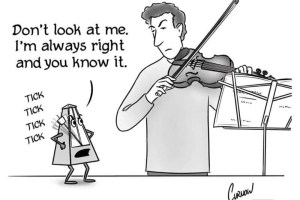
2. Follow a slow and a steady pulse (e.g. metronome beat) and if you make mistake don’t stop but keep going.

3. Look ahead by a few notes, just the way we do while driving.

4. Practice regularly. Daily practice for a few minutes is enough in the beginning until you build up your attention span.

5. Make your piece sound as expressive as you can.

There are many resources that you can use. These days apps are very popular and many of them have sight reading examples arranged level wise. RCM four star sight reading books are also a great resource as they are available level-wise.

Read, read, read, as much as you can. With consistent deliberate practice, you will see ourself getting better.

Happy reading!

How do you practice piano when you don’t feel like it?

2–3 minutes

What if you are dreading your practice time, you’re feeling bored or burnt out? Remember, You are not alone. Every musician feels like this from time to time. But how do you overcome the feeling and make your practice time more fun, relaxing and enjoyable, at the same time productive?

Practice blues are real, but temporary and you can overcome them. Playing the piano is a very rewarding activity if we learn to deal with our practice blues. Here are some strategies you can try. You can try either one at a time, or combination of a few together and see what works best for you:

1. Practice in short sessions multiple times instead of one long session- Learning new techniques, repertoire, or developing overall musicianship involves hours of hard work to get things sounding right. So if you practice in shorter sessions, your ability to focus improves exceptionally. Your chances of getting burnt out are far less if you use this approach.

2. Learn easier pieces for fun- You can try etudes/repertoire lower than your present level to keep your practice fresh. This will also help you to get to a performance level quicker and keep you motivated. To start with, it is a good sight reading practice.

3. Make your practice space relaxing and quiet- Your practice environment should be free of distractions to help you focus better and at the same time, enjoy the music you make. Distractions can lead to poor practice habits which in turn can affect your productivity.

4. Listen to/ watch the (video) recordings of the repertoire you are working on- Active listening is an important activity for developing musicians. It helps you drift your attention to many details you might have not noticed on the score while you were playing. Listening to concert pianist play is not only a great way to get inspired but it also helps you to listen to different interpretations, and techniques used. It is a fun way to take some break from playing but still be productive.

5. Watch your own old videos- When you look at yourself playing in an old video, this really helps you to reflect on how far you have come. This is always very motivating especially when you are not feeling like sitting at the piano and do all the hard work. It’s charges you up.

6. Take a break and go for a walk- If any of the above don’t work, there are high chances you need a little break from music making. Taking a day off is great too! So do not feel guilty of not practicing at all for a day or two. Take that time to gather yourself. There is no harm in this stretegy.

To sum up, Piano playing is hard work and it does need a lot of mental stamina and perseverance to keep going. Be mindful of the way you feel each day, before and after your practice session and I am sure you will be able to tackle “practice blues” and achieve success in your music endeavors.

Happy Practicing to all!

How to deal with mistakes in piano practice?

1–2 minutes

Whether you are a pro or a beginner, mistakes are a crucial part of any musician’s journey. Remember, everyone makes mistakes. Mistakes are necessary to move through the learning curve.
The question you need to ask is- Are you noticing your mistakes? If so, then mistakes are very helpful. Identifying all the areas/spots on the score and being aware about them, will bring progress.

There are two ways to deal with them-

  1. Isolating those spots and working/drilling them
  2. Slowing down on that section to fix any rhythm, note or articulation error, for instance.

    One very important thing to do, is to observe if it is only a few spots or you are overall making a lot of errors. For the latter, the easiest and most effective rule is to SLOW DOWN (your tempo).
    Each time you mess up, you should identify the root problem, drill it or slow down, if needed, and this will make you a skilled and knowledgeable musician. Then, the next time you are confronted with that technical challenge, you know what to do.
    Enjoy practicing! 🎹

    Happy to be a part of your musical journey!

Why should you learn to play the piano?

1–2 minutes

We have heard and read many researches that talk about the benefits of playing the piano for our physical, mental and emotional health. But is that it? Today I would like to share my thoughts on the value of playing piano.

We are all aware that piano playing is a fun and rewarding activity. It can bring us joy to express ourselves, and even serve as a therapy. When we play the piano, we are not just entertaining ourselves and others, but we are also engaging in a practice that has deep cultural and historical significance. The piano has been a fixture in music for centuries, and has played a key role in the development of many genres and styles. 

But beyond that, playing the piano requires discipline, focus, and dedication. It challenges us to improve our skills, to tackle difficult pieces, and strive for excellence. In doing so, we build valuable traits that can serve us well in all our lives. 

How to get your kid to practice piano and like it?

1–2 minutes

Learning a new skill does call for patience, perseverance and practice. We all know that without practice one cannot progress in the world of music.
Parents often struggle with having their kids to practice on a daily basis. Ideally, students shouldn’t need to be reminded to go practice piano. Our goal is to make them self-motivated.
Here are some useful tips for parents to make their child’s practice time more enjoyable and successful at the piano-

  1. Having a suitable environment-
    These days, we are surrounded by distractions. Make sure your child’s practice space is not having any distractions such as television, devices, video games and so on. That way they can focus and learn.
  2. Having an instrument-
    Make sure your child has the best instrument for your budget. Keep the instrument well maintained; if it is an acoustic piano, have it tuned on regular basis. Have all their music books, pencil, metronome accessible in their practice area. Also, if a child likes his/her instrument, his practice will be enjoyable and rewarding.
  3. Having a practice routine-
    Consistency is the key. Make a practice routine for your child and help him/her stick to it by setting up a specific time each day. Ideally a student should practice 5-6 days a week.
  4. Taking lessons regularly-
    Parents who get their kids on time to the lessons, making sure their child is well-rested, fed and eager to learn, who meet regularly with the teacher to discuss their goals and progress, are doing things right for their child’s journey.

Parents and teachers play a very important role in a child’s life. It is crucial for us to make sure our child progresses through consistent, enjoyable, deliberate practice. Encouraging your child to discover the joy in playing an instrument is one of the best things we can teach and give them. Hopefully implementing some of these tips will help!

Benefits of Music Exams

“Music gives a soul to the universe, wings to the mind, flight to the imagination and life to everything.” -Plato

1–2 minutes

Music exams are conducted by many institutions depending on where you live. In North America (Canada and USA), we have national standards established by The Royal Conservatory of Music (RCM) and Associated Board of the Royal Schools of Music (ABRSM). These exams are great for receiving formal education in music, be it for any instrument or voice exams. There are many benefits of taking these exams.

1. Music exams provide an established goal to work towards.

2. Exams impart structure as each level has set expectations.

3. Preparing and completing the exam successfully can provide immense satisfaction.

4. Detailed feedback provided by the examiners help students focus on the areas of improvements

5. RCM exams provide a national standard for teachers, and students to measure progress (ref: RCM portal)

6. It is a great motivational tool as students strive to become a better musicianship

7. Acquiring certifications can offer a broad career path as they can become teachers, accompanist, participate in band orchestra, concerts and earn a living

8. Overall, musicians are well respected and recognized in the community.

Students benefit tremendously and show improvement in increased attention span, building confidence and self-esteem, improves their financial status, develops patience and ability to persevere by going through examination process. Exams are great way for receiving formal education in music.

To sum up, taking music exams is an outstanding decision one can make for learning an instrument and getting enough joy and satisfaction out of it.

Importance of using Metronome in Piano practice

Metronome is a device that produces a click sound on a steady pulse/ tempo. Tempo is measured in Beats Per Minute (BPM). Example, a clock ticks at 60 times a minute, so it’s tempo is 60 BPM.
The name metronome comes from Greek words metron meaning “measure” and nomos meaning “regulating”.
Music is all about Pitch and rhythm. Metronome is a very important practice tool and below are a few important uses of metronome-
– Its helps you to focus on the rhythm of a music piece or a song
– It helps you to track your progress. E.g. If you are practising a scale or an exercise on 60 bpm, you can gradually increase your speed to 65 or 70 and so on.
– It helps you find errors. E.g. if you fall behind (say get slower) in a particular section of a song, then it’s best to practice the entire song at a slower tempo to stay on the beat.

All in all, Metronome is a critical tool to shorten your learning curve.

Optimizing the Piano practice

1–2 minutes

In this article, I will give you few tips to optimize your piano practice:

  1. Schedule your practice time-Learning piano is a commitment you make to yourself.  Respect your practice time and if possible practice same time every day.
  2. Have a goal for a day/week/ or even 1 practice session- Before you even start your warm-up, you should decide a goal for your practice session. Goals can be as detailed as what piece, which measure, HT or HS, what tempo and so on.
  3. Practice more on your problem areas – It is very tempting to practice things that you are good at. However, it cannot help you with your problems/weaknesses. It can be anything as small as a “measure of a piece” you are struggling with or as big as a “technique problem”.

I hope you would be able to put into practice the above tips and excel in playing Piano. As always, I encourage you to express your concerns and excitement about your progress.

Secret of Musicians- Muscle Memory

1–2 minutes

In the world of Music, musicians play a piece either by Sight reading or Memory or both.

Today, lets understand what it means by playing a piece “by Memory”. We will talk about playing by “Sight reading” in our later articles.

Repetition is the key to memorizing a piece. When you play a piece without thinking it means it is now set in your muscle memory.  Inherently, this also helps you develop an important skill – Patience. The biggest advantage of muscle memory is that it stays with you for a long time.   While you are trying to memorize a piece, you are training the movements of your muscles in a specific way and with practice it comes out automatically/ naturally (as it is in your memory).

However, on the contrary, same rule also applies when you practice your piece incorrectly. Be mindful and don’t practice your mistakes i.e. repeating wrong techniques as it will get registered in your memory. This is a big watch out as it takes time to reverse your mistakes and then learn the right way.

If you were to remember one thing in Music, remember this- accuracy is important than speed. Practice makes you perfect.

It’s not a race to win but it’s a “Journey to Success”.

The Power of Perseverance

DO IT!
1–2 minutes

There is a very well-known quote by Helen Hayes, “The expert at anything was once a beginner.  When you begin your journey to be a musician, you need patience, practice and PERSEVERANCE.

So, what is PERSEVERANCE? It is the determination to keep going or the will-power to continue your journey.

 A journey of a musician is like a roller coaster ride.  Whether you aspire to become a concert pianist or play just for fun, you will sometimes feel as if there is “No progress” and that’s called PLATEAU.  It could last for as short as a week or even months. Plateau is a period of accumulation meaning whatever you learn – techniques, pieces, muscle memory; they are all advancing but you may NOT notice the progress until one day when you suddenly realize that you are able to do it!

So, have a ‘Don’t quit’ attitude, and keep working towards your dream to play Piano.

Happy Practicing!