RCM Certificate Program- Checklist for the Remote exam:

1–2 minutes

βœ“ A completed Program form on your RCM dashboard at least a few days ahead of the exam
βœ“ An appropriate instrument- a digital or a tuned acoustic piano
βœ“ Laptop with mic and camera access
βœ“ Reliable Internet access
βœ“ Any repertoire you are not performing from memory
βœ“ Sight reading sheet (RCM uploads the sight reading material no later than 22 hours before
the exam)
βœ“ Zoom app downloaded on the device

Further guidelines:
βœ“ Be sure to confirm the date and time of the exam.
βœ“ A sound check at least a few hours before the exam is recommended.


@pianovibes06

What does healthy piano technique mean and how to develop it?

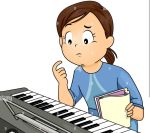
A good piano technique is dependent on having rounded fingers
1–2 minutes

Piano playing involves use of intricate gestures and complex choreography. A good warm up routine can enhance your technique at the piano and help you play with a relaxed posture.

Healthy technique comprises many aspects such as sitting correctly at the piano, using various touches on the piano with ease, playing different scale, chord and arpeggio patterns in all the keys, having a natural curve in fingers, having shoulders relaxed, use of flexible wrist and arm weight, proper breathing to avoid stiff muscles while playing, choosing correct and consistent fingering, and practicing mindfully. A good technique can be developed through awareness. It is imperative that you take breaks to avoid fatigued muscles.

In addition to preventing injuries, a well-honed technique can enhance the enjoyment of playing the piano. Good technique can take time to develop and the guidance of a good teacher can make this process stress free.

To summarize, a healthy piano technique can be developed by being mindful at the piano of how to use your whole body in an efficient way.

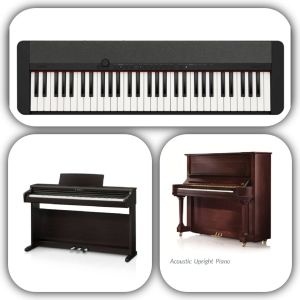
Keyboard VS Digital Piano VS Acoustic Upright Piano: Which one is better and why?

Keyboard VS Digital Piano VS Acoustic Upright Piano

1–2 minutes

The term ‘Piano’ is often treated as generic. But, can we call a 61 keys keyboard a piano? The answer is no. We first need to understand the difference between a piano and keyboard.

The main difference is in the feel of keys. A keyboard does not have weighted keys whereas digital and acoustic pianos do. Weighted keys of piano play an integral part in the development of technical skills, finger dexterity and strength of the player. Dynamic range, various touches such as staccatos, accents etc. can be played only on a piano as they have weighted keys. Furthermore, the sound quality of a keyboard is not as good as a piano. Piano’s sound is generated when the hammers strike the string. The keyboard, on the other hand produces their sound by way of a synthesizer rather than strings and hammer.

One more problem with a keyboard is it normally has lesser number of keys than a piano which restricts the range for the beginner.

Pianos can be digital or acoustic. Though the latter is the best for technical development, sound quality and overall experience, it needs more maintenance than a digital piano and might not fit in the budget of everyone. Whereas, digital pianos need very less maintenance but does the job. However, some cheap digital pianos may not provide the same level of experience as expensive ones. Digital pianos in the starting range can compromise on the quality, sound and feel of the keys.

Both digital and acoustic pianos come with a three pedal unit while most keyboards don’t. Pedal technique is another very important skill that a pianist should aim for.

Even though pianos would take up more space and are not portable as the keyboard, if you are serious about learning good techniques, a piano- digital or acoustic is preferable for home practice.

How long does it take to learn piano?

1–2 minutes

This is one question I get asked very often.

Learning to play piano is the same as learning any other skill such as swimming, learning a new language, a new software program and so on.

Like with any other skill, consistency in practice is the key. It is important to hire a good teacher who can motivate and guide you. It is critical to be regular with your piano lessons once you have found a teacher.

Most probably, you will learn the very first song in your first lesson. But remember, to be able to play your favorite songs, it is important to learn the required skills, techniques, various touches, pedaling, correct use of hand and arm movements and so on. You will have to be patient and diligent.

Similar to grades in schools, piano studies are also graded. You need to go through levels in order to achieve proficiency to a certain degree. The famous composers’ pieces such as Bach, Mozart, Clementi, Handel at an elementary level, can be tackled after 3-4 years of setting a foundation on good technique, note reading skills, basic ear training and so on. The intermediate level would probably last longer than elementary, because there are a lot of composers, different styles, genres, and techniques.

To summarise, it is difficult to give an exact answer to this question because your progress is vastly dependent on the amount and consistency of practice you can put in, availability of teachers, practice strategies, etc. However, if you are dedicated to learning this art, it is one of the most rewarding, no matter what level you are at.

Understanding Rhythm- a fundamental element of Music Education

1–2 minutes

Rhythm and pitch are two important components of reading music. While pitch reading is added a little later in a beginner’s learning, understanding to feel the rhythm is very crucial. Rhythmic awareness can be developed by proper training, though some people have an innate ability to perform music following a steady beat.

Rhythm provides a framework to help understand how music holds together. Rhythmic activities involve clapping, tapping, stomping, and playing percussion instruments which helps children understand to interpret and perform music accurately. These activities help develop fine motor skills and hand eye coordination in young musicians. Furthermore, metronome is an important device for students, as it helps in understanding a steady pulse. Here is an article about Metronome (see link below).

Learning different kinds of subdivision of rhythms help develop mathematical skills and feel a strong sense of timing. Rhythm can also convey different moods of music such as tension, energy, relaxation and so on.

All in all, incorporating rhythm in music education helps develop cognitive, emotional, aural, and visual skills.

Article on Metronome Practice

Efficient practice Vs Mindless practice

2–3 minutes

I have written a blogpost on mindless practice earlier. Here is the link to that post, 

How to avoid mindless practice at the piano 🎹?

Here I will elaborate further on steps to avoid mindless practice, what efficient practice is and so on. 

While efficient practice at the piano yields great results, mindless practice can be detrimental to your progress at the piano. Let’s first understand what does mindless practice mean.

Mindless practice would include practicing in auto-pilot mode, repeating a section of a piece a few times without being able to rectify errors, always practicing playing through the piece and never working on trouble spots, only focussing on the time spent at the piano rather than thinking of specific work needed and practicing without any goal in mind. 

It is very easy to get into the rut of mindless practice if you are not reflecting on your practice sessions. The following steps can help you practice better:

1. Have a practice goal before you begin your practice session. Be specific of your goals. It can be as specific as-  “I need to bring out the melody of this piece.” or “I need to feel the pulse of 2/2 in this piece by exaggerating the beats”.

2. Depending on the time you have to practice, take a few minutes to map out as to what you would like to achieve in your practice session for each technical exercise, etude, repertoire, and musicianship that you are working on. 

3. Do not always start from the beginning of the piece. Practice in small sections (measures or phrases), hands separate, hands together, increasing number of  repetitions and so on.

5. Identify the trouble spots. Whenever you are practicing a small section, identify and mark all the measures on the score that is giving you trouble. This will also help in goal setting for the next practice session.

6. Lastly, record your practice session in a journal. This is basically reflecting on your practice. You can write what worked in your favor and what did not, record on any ideas on improving your next practice session such as exaggerate on dynamics to make more contrasts. For example, if you are trying to speed up a piece, write down the tempo you were able to efficiently handle the piece.

The above steps can be applied at any level of proficiency, whether you are a beginner, intermediate or advanced. 

To conclude, piano playing involves numerous technical challenges. These techniques cannot develop overnight. It needs consistency, discipline, motivation, positive attitude, a musical mindset, and efficient practice strategies.
What happens to the learnt repertoire during summer holidays, if left untouched?

Many students take a break from lessons during summer holidays. When students look forward to a vacation from typical learning and enrichment activities, they often fail to maintain musical skills or cease learning new ones during the long break from lessons. This could be detrimental to their progress in piano studies.

There is one important aspect- sleep- that we should consider for using it in marinating new information learnt. Sleep, essential to memory and motor skills consolidation is helpful to get the repertoire to the next level, as students tend to get better sleep during summer holidays.

When the repertoire is left untouched for a month or two, it leads to loss of technique. Due to break in lessons, there are chances that students do not feel motivated to practice enough.

To sum up, when new repertoire is learnt, practice must occur with consistency over time.

How to avoid mindless practice at the piano πŸŽΉ?

1–2 minutes

1. Make a balanced practice plan– Begin your practice with warmups (could be technical exercises). The pieces which need the most attention (e.g. new ones, or if you are preparing pieces for an upcoming exam or performance) should be dealt with first. You should include sight reading and ear training in your practice session.


2. Have some short term practice goals.– These can be written for either for a day or the whole week- Make S.M.A.R.T goals. S-Specific, M- Measurable, A-Achievable, R- Relevant, T- Time-specific


3. Stick to the plan keeping your goals in mind– If you have made your goals based on SMART, it is likely you will not deviate from them.


4. Take short breaks after every 25 minutes of practice- According to researchers, it has been shown that humans can focus for 25 mins at one time. In order to make the most out of your time at the bench and prevent yourself from becoming stiff, it is crucial that you take breaks.


5. Change your order of practice to avoid getting into auto-pilot mode- If you have the same system of practice daily, there are chances that it will lead to robotic playing. Music is all about artistry, imagination and expression. So, this strategy will be very helpful to keep you inspired and play with ease.

‘Sweat’ or ‘Regret’

No Shortcuts, Work for it!
1–2 minutes

In today’s INSTANT age, we want to achieve success right away. But is that really possible?
Learning a new instrument, language, a new computer software or any skill requires consistent hard work and practice. The idea of persistent effort is becoming a foreign concept. We need to instill the importance of perseverance in today’s generation.
But, how will we be able to do that?
Getting our kids to start learning a skill, persevering to achieve success, enjoying the process of learning, accomplishing a certain degree of proficiency, not worrying about making mistakes, sharing it with other people, striving to achieve excellence, are some of the steps they need to go through. The idea of giving up learning something because they feel it is too hard is not good and should never be encouraged.
We often hear that young children learn faster than adults. This is true and as parents it is important that we enroll them in activities that challenge them and at the same time, it is important to direct them in something they would be able to carry with them throughout their lives and enjoy doing it. Children spend or rather waste a lot of time on devices, and video games. If they invest the same amount of time in mastering a new skill, it would not only be rewarding but it will also increase their self confidence and give them a feeling of self fulfilment and maybe a career opportunity. Your child’s future is in your hands. Inspire them to aspire and perspire.